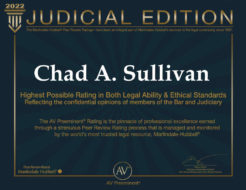
Chad A. Sullivan

Partner

About

Chad Sullivan is a trial lawyer and a Registered Nurse with years of practical experience representing clients in Louisiana's state and federal courts and before administrative panels.  These include the State Board of Nursing and Louisiana Patient’s Compensation Fund.

Chad regularly handles difficult cases involving insurance defense, malpractice, defective products, impaired professionals and licensure claims involving:

  • Physicians
  • Nurses
  • Pharmacists
  • Nursing homes
  • Physical therapists
  • Home health agencies

Most of his clients are Louisiana-based entities, although, in the case of litigation involving medical devices, most of his clients are out-of-state companies doing business in Louisiana.

Chad applies his nursing experience in his personal injury practice, as well, in claims involving automobile, industrial or other accidents.  This experience is also vital to the complex litigation claims he handles, which include catastrophic accidents resulting in major property loss, serious injury or wrongful death.  His medical background and responsiveness are factors in his frequently being chosen as “Attorney Chairman” in medical malpractice cases, a role chosen by both sides to facilitate the medical review panel process.

As an added asset to his clients, he closely monitors the latest medical developments and advancements in treatment options, including interventional pain management techniques, focusing on outcome results and efficacy.

  • Personal Injury

  • Defends clients in litigation in the areas of auto accidents, medical device litigation, pharmaceutical litigation, UM/UIM claims
  • Defends medical professionals, including nursing homes, in medical malpractice actions
  • Represents clients injured in automobile accidents and those injured as a result of medical malpractice
  • Represents a number of professionals, including RNs, physicians, pharmacists, licensed counselors and physical therapist, in disciplinary hearings before their respective boards
  • Serves as Attorney Chairman in medical malpractice cases

  • Baton Rouge Bar Association
  • Louisiana State Bar Association
  • The American Association of Nurse Attorneys
  • Healthcare Compliance Association

  • Past board member, Baton Rouge Boys & Girls Club
  • Trustee, Louisiana Nursing Foundation, 2014 – current
  • Member, St. George Catholic Church

Practice Areas

Education

  • J.D., Louisiana State University Paul M. Hebert Law Center, 2001
    – CALI Award in Copyright, Trademarks and Intellectual Property
    – Chancellor’s List in 2000 and 2001
    – Recognized in Who’s Who Among American Law Students in 2000 and 2001
  • George Washington University, 2010
    – Certificate in Health Care Compliance
  • B.S.N., McNeese State University, 1997
    Cum Laude

Admissions

  • Louisiana, 2001
  • U.S. District Court for the Eastern District of Louisiana, 2001
  • U.S. District Court for the Middle District of Louisiana, 2001
  • U.S. District Court for the Western District of Louisiana, 2001
  • U.S. Court of Appeals for the Fifth Circuit, 2001

Accolades

Recent Articles by This Attorney

Explore this author's legal perspectives on issues shaping Louisiana.

Insight

Louisiana Changes Prescriptive Periods for Survival and Wrongful Death Actions

Pursuant to House Bill 291, Louisiana modified the prescriptive dates for wrongful death and survival actions. Survival actions are brought to recover damages a deceased person suffered before his or her death. For survival actions, La. Civil Code Article 2315.1 (A) now provides as follows:

If a person who has been injured by an offense or quasi offense dies, the right to recover all damages for injury to that person, his property or otherwise, caused by the offense or quasi offense, shall survive for a period of one year from the death of the deceased or two years from the day that injury or damage is sustained, whichever is longer.

A wrongful death claim can compensate the surviving family members for their own suffering following someone’s death. Similar amendments were made for the wrongful death statute. La. Civil Code Article 2315.2(B) now provides that the right of action for wrongful death prescribes one year from the death of the deceased or two years from the day that injury or damage is sustained, whichever is longer.

The changes to these articles went into effect August 1, 2025.

Insight

Louisiana Legislature Sets New Prescription Period for Tort Claims

The Louisiana legislature recently enacted laws that set new prescription periods for most delictual/tort actions and claims for damage caused to immovable property. Civil Code articles 3492 and 3493 previously established a prescription period of one year for these types of claims. The legislature repealed these articles and enacted Louisiana Code Articles 3493.1 and 3493.2 in their place.

Louisiana Code Article 3493.1 now establishes a prescriptive period of two (2) years for delictual actions/tort claims that runs from the day injury occurred or damage is sustained. It contains language previously included in Louisiana Civil Code Article 3492, which states that prescriptive period does not run against minors or interdicts in actions involving permanent disability and brought pursuant to the Louisiana Products Liability Act or state law governing product liability actions in effect at the time of the injury or damage.

Louisiana Civil Code Article 3493.2 also establishes a prescriptive period of two (2) years when damage is caused to immovable property. This prescriptive period runs from the day the owner of the immovable acquired, or should have acquired, knowledge of the damage.

These changes went into effect of July 1, 2024. Louisiana Civil Code Articles 3493.1 and 3493.2 apply prospectively only and apply to delictual actions arising after July 1, 2024.

Insight

Supreme Court Establishes Shifting Burden of Proof for Additional Medical Opinions (“AMO”)

Louisiana Code of Civil Procedure article 1464 allows a defendant to select a physician to perform a physical and/or mental examination of a plaintiff to challenge the plaintiff’s claimed physical and mental injuries. This is called an Additional Medical Opinion (AMO); this was previously referenced as an Independent Medical Examination (IME). Earlier this year, the Louisiana Supreme Court, outlined the “good cause” requirement of the statute—an essential element required to proceed with an AMO. But, what remained as a question was the scope of an AMO and which party had the burden to deal with requested restrictions on the physician’s medical exam. This question was answered: In Augustine v. Safeco Insurance Company of Oregon, the Louisiana Supreme Court held that after “good cause” has been shown for the examination, the party seeking to limit the scope of the AMO bears the burden to justify the restrictions.

In Augustine, a sequel to Hicks v. USAA General Indemnity Company, Et al, the Court held that if the party to be examined for the AMO, usually the plaintiff, wants to place limits upon the examination, that party then has the burden of proof to justify the need for any restrictions or limitations with competent evidence. This ruling appears to show a trend in which the Court is confirming a defendant’s ability to obtain an AMO to support its defenses to a personal injury claim. Augustine follows another Supreme Court decision from March of 2022, in which the Court held that a party establishes “good cause” for an AMO if that party shows a “reasonable nexus” between the requested examination and the condition in controversy. See Hicks v. USAA General Indemnity Company, Et al. The Hicks decision eased the hurdles that defendants faced when seeking to compel AMOs pursuant to Louisiana Code of Civil Procedure article 1464. For more information on the Hicks decision, see our prior blog here. Supreme Court Clarifies “Good Cause” for Additional Medical Opinion (“AMO”) (keoghcox.com)

In Augustine, the defendants requested an AMO. The plaintiff agreed to the examination, but the parties were unable to agree on “certain restrictions” the plaintiff sought to impose on the scope of the examination. The defendants ultimately filed a Motion to Compel regarding this issue. The District Court limited the examination to only those tests that the plaintiff’s treating physicians had performed. The District Court also noted that it did not want the AMO to turn into a “fishing expedition.” The Court of Appeal denied the defendant’s request for review of the Trial Court’s decision. The defendants then sought relief from the Supreme Court, which vacated the Trial Court’s ruling and remanded the case for further proceedings consistent with its opinion.

In its opinion, the Supreme Court set forth the burden of proof each party has in the context of a Motion to Compel an AMO. As outlined in Hicks, the party requesting the AMO initially has the burden to establish “good cause” for the AMO. Importantly, the Augustine court found that once “good cause” has been found, “the court should presume that the examination will be conducted in a reasonable manner.” Because it is presumed the examination will be conducted reasonably, if a party opposing the AMO wants to place restrictions on the examination, the burden now shifts to that party to establish “special circumstances” that justify the restrictions they request. To meet this burden, the opposing party must produce “competent evidence” to establish (1) the need for the restriction and (2) that harm that will result if the restrictions are not imposed. The type of evidence that may support AMO restrictions under Augustine likely will vary depending on the unique facts of each case. However, Hicks and its “sequel,” Augustine, provide clarification and guidance to parties seeking to compel or limit an AMO under article 1464.

Case References:

Augustine v. Safeco Insurance Company of Oregon, 2021-01753 (La. 10/1/22), __ So.3d __.

Hicks v. USAA General Indemnity Company, Et al., 2021-00840 (La. 3/25/22), 339 So.3d 1106.

Written by Chad A. Sullivan and George A. Wright

Read our Latest Blogs Providing Insight on Important Legal Matters

No items found.