Insight
Now You See Us
Published on: September 22, 2015

Keogh Cox is proud to announce the placement of a new sign and logo on the exterior of our office building in Baton Rouge, Louisiana.
Keogh Cox’s offices have long been situated in the heart of downtown Baton Rouge in a convenient and historically significant location. Clients, drivers, and passers-by will now be better able to see us, day or night.
Keogh Cox & Wilson, Ltd. provides this blog as a public service for general information only. The materials contained herein may not reflect the most current legal developments or even express the opinion of all or even most of Keogh Cox attorneys. Such material does not constitute legal advice or form any attorney-client relationship. Keogh Cox and all contributing author(s) expressly disclaim all liability to any person with respect to the contents of this Web site and Blog and expect that no reliance will be made upon the information provided.

In a 68 page decision, the Louisiana Supreme Court in Hayes Fund for the First United Methodist Church of Welsh, LLC, et al. v. Kerr-McGee Rocky Mountain LLC, et al. forcefully explained the role of an appellate court. It is axiomatic that Louisiana appellate courts are courts of review. Louisiana law specifically sets the standard of review an appellate court must apply when reviewing a trial court’s factual decisions (manifest error) or its legal decisions (de novo). According to Hayes Fund, a failure to faithfully apply the “manifest error” standard of review where applicable causes an appellate court to function as a “choice-making court” when its proper role is to serve as an “errors-correcting court.”
The plaintiffs in Hayes Fund alleged that negligence by Kerr-McGee caused two wells to stop producing, leaving valuable assets out of reach. After a lengthy bench trial which spanned a ten-month period and involved over twenty-five days of live testimony, the trial court found that the plaintiffs failed to meet their burden to prove that the defendants caused the loss. Thereafter, the Third Circuit reversed the finding of the trial court as an abuse of discretion.
The Supreme Court reversed and reinstated the ruling in favor of defendants. The Court found that the primary issues in the trial court were factual issues concerning whether the experts were credible or factually correct, thus the “manifest error” standard of review should have been applied.
According to Hayes Fund, the manifest error standard of review is accomplished by undertaking a two-step process which asks: 1) whether there was any factual basis for the trial court’s conclusions; and, 2) whether the findings of the trial court were “clearly wrong.” Applying this test requires the appellate court to do more than “simply review the records for some evidence, which supports or controverts the Trial Court’s finding.” Instead, the appellate court must review the “entire record.” The Court cautioned that an appellate court is not to “re-weigh the evidence or to substitute its own factual findings just because it would have decided the case differently.”
Through its conclusion, the Hayes Fund Court provided clear guidance moving forward, stating:
Rarely should a District Court’s choice of expert(s) be found clearly wrong because it is so difficult to find a reasonable basis does not exist for the expert’s opinion relied upon by the District Court. It is destructive to the manifest error analysis for a reviewing Court to make its choice of the evidence rather than look for clear error in the reasonable basis found by the trier of fact. We have tortuously studied this scientific and voluminous record to demonstrate a proper manifest error review.
By its own terms, the Court intends the Hayes Fund decision in to provide “guidance” as to the “proper analysis for the reviewing Court(s).” While the principles discussed in Hayes Fund are not new or novel, the emphasis given by the Court was uniquely passionate and likely to quickly become a focus of future appellate argument and briefing.

In the recent case of Riedel v. Fenasci,2018-0540 (La. App. 1 Cir. 12/28/18), _______ So. 3d _______, 2018 WL 6818716,home buyers sued the sellers and the involved real estate agents after mold wasdiscovered shortly following the sale. This is a common fact pattern in humidSouth Louisiana. The buyers lost in the trial court when there was no evidencethat the sellers or the agents knew of the problem. The result was affirmed bythe First Circuit Court of Appeal.
The Riedels identified mold weeks afterthe closing and filed a claim with their homeowner’s insurer. But the claim wasdenied when the insurer’s inspection revealed long- term damage, rot, anddeterioration in a ceiling due to water damage. That finding prompted thesuit.
Against the sellers, the Riedels contendedthat they “had to have known” about the moisture and mold in the home prior tothe sale. Because the home was sold “as is,” they had to establish fraudto recover. However, the sellers had not lived in the home for years and hadreceived no complaints from tenants over this time. Under such facts, the claimof fraud was not supported.
The Riedels also sued both agents for negligent misrepresentation, and their own agent for breach of fiduciary duty. In assessing the claim against the agents, the Riedel Court agreed that real estate agents are liable for negligent misrepresentation when they fail to disclose hidden defects in the property which were known or should have been known to them. The Court also agreed that a purchaser’s real estate agent owes a fiduciary duty, the highest duty of care recognized by law. Nevertheless, when the plaintiffs’ own inspector found no visible evidence of mold prior to the sale and there was no indication that the agents possessed prior knowledge of the mold, the claim against the agents was also dismissed.
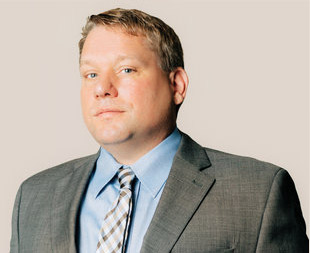
Marty Golden has been practicing law based in Baton Rouge, Louisiana for over thirty years, concentrating in civil litigation primarily involving injuries, property damage, insurance coverage, and contract disputes. Much of his practice is defending and advising real estate agents in suits by property buyers and sellers, but Marty also defends other professionals, insurance companies, manufacturers, and business owners. Marty has a special interest in all things procedural, because they are the rules of the road for litigators and knowing them better than his opponent gives him a leg up in court.
Keogh Cox is proud to announce the placement of a new sign and logo on the exterior of our office building in Baton Rouge, Louisiana.
Keogh Cox’s offices have long been situated in the heart of downtown Baton Rouge in a convenient and historically significant location. Clients, drivers, and passers-by will now be better able to see us, day or night.