Insight

Outdoor Living:  Federal Court Rules That Uneven Terrain in Parking Lot Does Not Present an Unreasonable Risk of Harm

Published on: October 5, 2022

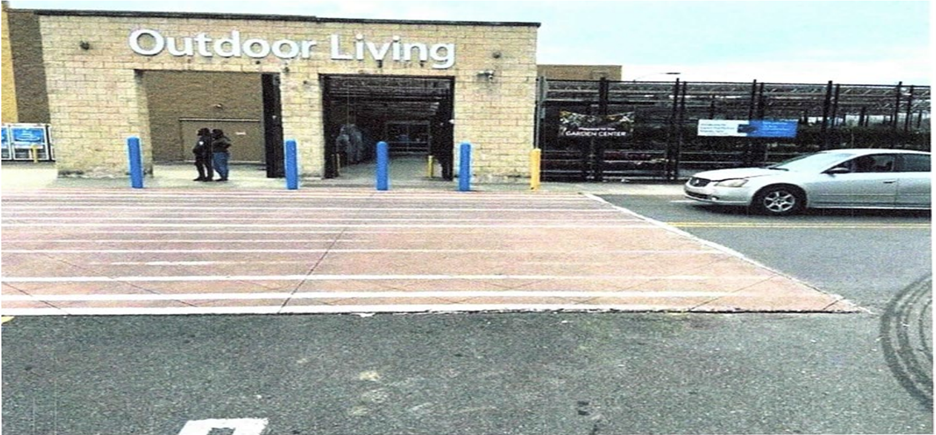
A federal court for the Middle District of Louisiana recently ruled that a 1½ inch elevation change in a Walmart parking lot did not present an unreasonable risk of harm to the plaintiff patron in Lacaze v. Walmart Stores, Inc. The case involved a slip and fall/trip and fall accident in the parking lot of Walmart’s Burbank Drive store in Baton Rouge. The defendant moved to dismiss the suit where the plaintiff claimed she tripped and fell as she crossed the area where the black asphalt parking lot adjoined the concrete crosswalk as pictured below.

In the area where the asphalt meets the crosswalk, the surface presented a ¼ inch to 1½ inch change in elevation. Plaintiff admitted the black pavement was distinct in appearance and color from the concrete crosswalk. Surveillance showed that plaintiff looked down at her cell phone at the time she tripped and fell. Though in a high pedestrian traffic area, Wal-Mart maintained this was the first reported incident.

The Court found the condition was open and obvious and did not present an unreasonable risk of harm. To reach this decision, the Court made the following observations:

  1. Parking lots have clear and apparent utility. Crosswalks do as well. Crosswalks give patrons a designated area to traverse the lot safely.
  2. The likelihood and magnitude of the risk posed by the condition was low. The Court noted it is common for surfaces of parking lots and sidewalks to be irregular, and no other patrons reported problems or accidents.
  3. The cost of preventing the harm was high. The Court would not consider only the cost of fixing the specific injury-causing defect. Rather, it considered the cost of eliminating all defects in the Walmart parking lot.
  4. Plaintiff conducted an ordinary commercial activity that was not dangerous in nature.

The Court concluded that all but factor four pointed to a single conclusion: the 1½ inch elevation difference did not pose an unreasonable risk of harm. The Court reached this conclusion even though the plaintiff retained an expert who gave opinions regarding possible violations of the Americans with Disabilities Act (ADA) and OSHA regulations. The expert’s opinions were insufficient to defeat summary judgment when the condition was open and obvious. In reaching its ultimate conclusion, the Court joined with several other courts, including the following:

  • Chambers v. Vill. of Moreauville, where a one-and-one half inch deviation did not present an unreasonable risk of harm;
  • Reed v. Wal-Mart Stores, where a height variance of one-fourth to one-half inch between concrete blocks in parking lot did not present an unreasonable risk of harm; and
  • Boyle v. Board of Sup'rs, Louisiana State University, where a depression of up to one inch in a sidewalk did not pose unreasonable risk of harm.

Case References: Lacaze v. Walmart Stores, Inc., No. CV 20-696-JWD-EWD, 2022 WL 4227240 (M.D. La. Sept. 13, 2022); Chambers v. Vill. of Moreauville, 2011-0898 (La. 01/24/12), 85 So.3d 593; Reed v. Wal-Mart Stores, 97-1174 (La. 03/04/98), 708 So.2d 362; and Boyle v. Board of Sup'rs, Louisiana State University, 96-1158 (La. 01/14/97), 685 So.2d 1080.

Posted by:

Disclaimer

Keogh Cox & Wilson, Ltd. provides this blog as a public service for general information only. The materials contained herein may not reflect the most current legal developments or even express the opinion of all or even most of Keogh Cox attorneys. Such material does not constitute legal advice or form any attorney-client relationship. Keogh Cox and all contributing author(s) expressly disclaim all liability to any person with respect to the contents of this Web site and Blog and expect that no reliance will be made upon the information provided.

Continue Reading

Explore legal perspectives on the issues shaping Louisiana's key industries and courtrooms.

Insight

What ifs….. Indemnifying Premises Liability Exposure

If you are a property owner, stop and think about the “what ifs” before you enter into a lease with a property manager or lessee. For example, what if an invitee of the property that you own is hurt while on and/or because of a condition on the property? Who is responsible?

A property owner may be able to transfer its potential liability to a property manager or lessee of the property if the lease contains an indemnification provision. However, not all indemnification provisions are enforceable, and these critical provisions are often litigated.

The Eastern District Court of Louisiana recently enforced an indemnification provision, granting summary judgment to a landowner who sought indemnification from its property lessee in Avila v. Village Mart, LLC, Civ. A. No. 20-1850, 2021 WL 4439579 (E.D. La. 9/28/21). In the case, a shopping center leased retail space to a men’s store. Before the store opened, a painter was injured when he fell from a ladder. The owner of the shopping center argued that the lessee owed a defense. It argued indemnity applied because the plaintiffs’ claims arose out of the lessee’s buildout construction, over which the owner did not have any care, custody, or control.

In response, the lessee argued that the owner was not entitled to indemnification because the plaintiffs’ claims did not “arise out of or were connected with Tenant’s use, occupancy, management or control of the Leased Premises.” The lessee claimed that it was not using, occupying, managing, or controlling the leased space because the only permitted use of the space was to sell menswear, and the space was not being used for this purpose at the time of the accident.

Louisiana courts often apply a “but for” causation test to such “arising out of” language in indemnity provisions. Avila, 2021 WL 4439579, at *5, citing Kan. City S. Ry. Co. v. Pilgrim’s Pride Corp., No. 06-03, 2010 WL 1293340, at *6 (W.D. La. Mar. 29, 2010), and Perkins v. Rubicon, Inc., 563 So.2d 258, 259-60 (La. 1990). The court observed the lessee’s arguments contradicted language in the lease that allowed the lessee to use and occupy the store before it opened to the public. The lease also explained that the lessee was responsible for certain construction work and identified specific dates to begin work and to open the store. Thus, the lease contemplated use and occupancy before the store was open to the public. The court found that the lessee’s possession of the space and its construction obligations under the lease established its use and occupancy of the space. The court stated:

Given the broad language in the indemnity agreement – ‘arising out of or connected with’ – [the plaintiffs’] injuries, resulting from his work as a subcontractor painting the premises leased by [the retail space lessee,] are connected to [its] use and occupancy of the premises. … Because [the retail space lessee] was in possession of the space, and had assumed responsibility for the buildout and for contractors and subcontractors working on the buildout, the Court finds that the plaintiffs’ liability theories fall within the scope of the indemnity provision in the lease. Avila, 2021 WL 4439579, at *6.

The enforceability of indemnity provisions such as the one examined in Avila will continue to be litigated. In the meantime, Avila reminds us of the importance of sound indemnity language to anticipate the “what ifs.”

Insight

Louisiana First Circuit Finds for State Trooper in Fatal Shooting

On July 27, 2023, the Louisiana First Circuit entered judgment in favor of Louisiana State Trooper Andre Bezou in the shooting death of Coltin LeBlanc. The case was defended by Keogh Cox attorneys Drew Blanchfield, Brian Butler, and Collin LeBlanc. In support of its ruling, the First Circuit cited La. R.S. 9:2798.1 which provides qualified immunity for an officer’s actions, unless their action constituted “criminal, fraudulent, malicious, intentional, willful, outrageous, reckless, or flagrant misconduct.” The court found Trooper Bezou was entitled to qualified immunity under the facts of this case.

After midnight in an area of Hammond, La. dotted with bars and restaurants, Trooper Bezou spotted LeBlanc driving a large Ford truck. Trooper Bezou testified that he witnessed two traffic violations and initiated a stop. “Bodycam” footage captured the interaction. LeBlanc exited the vehicle, and when the trooper asked for identification, LeBlanc indicated it was in his truck. LeBlanc moved to the cab of the truck, and Trooper Bezou followed, stopping within the open driver’s side door. Based upon his observations during this interaction, Trooper Bezou suspected LeBlanc was intoxicated. Later testing confirmed that LeBlanc had a blood alcohol level more than two times the legal limit.

But LeBlanc was not attempting to retrieve his license. Instead, he revved the engine and attempted to flee with Trooper Bezou immediately next to the vehicle. Trooper Bezou later testified he feared that LeBlanc would steer the vehicle to run him over with the back left wheel. In reaction, Trooper Bezou latched onto the truck and LeBlanc sped around a corner and down the roadway. Trooper Bezou was able to draw his weapon and gave multiple orders to stop. Trooper Bezou testified that he feared he would be thrown from the vehicle or scraped against parked cars in the area. When the trooper received no indication LeBlanc would relent, he opened fire. Thereafter, the truck came to a rest.

In the subsequent litigation, plaintiffs argued that Trooper Bezou used “excessive force” and should have attempted to move away and allow LeBlanc to flee the scene. In response, Keogh Cox cited Harmon v. City of Arlington, 16 F.4th 1159 (5th Cir. 2021), where the federal Fifth Circuit held that no “clearly established precedent” would prohibit an officer from firing while perched on the running board of a fleeing vehicle. Finding no excessive force under the facts of the case, Harmon acknowledged the simple truth that “there is an obvious threat of harm to an officer” who is “on the side of a fleeing vehicle.” The facts presented to the First Circuit showed that Trooper Bezou gave more warning to relent than was given in Harmon.

The New York Times covered this incident in an article titled, “Before the Final Frame: When Police Missteps Create Danger.” 11/17/21. In its coverage, the New York Times reported that Trooper Bezou “appeared to be in grave danger.” It then suggested that the trooper could have just backed away. However, courts are instructed not a gauge questions of immunity from an out-of-context application of “20/20 hindsight.” Because the facts in this case showed Trooper Bezou was in grave danger “at the moment” force was used and was faced with a split-second decision, he was protected from liability.

Insight

Louisiana Court Limits Use of Biomechanical Expert Testimony

The use of biomechanical expert testimony in Louisiana courts has evolved over the last few years. A recent decision from the Louisiana Fifth Circuit Court of Appeal provides an example of the changing standards for the admissibility of biomechanical expert testimony and its relation to medical causation.

In Pollard v. 21st Century Centennial Ins. Co., 21-65 (La. App. 5 Cir. 12/23/21), 334 So. 3d 1013, writ denied, 2022-00163 (La. 4/20/22), the defendants argued that the underlying accident involved a minor rear-end impact not likely to cause injury. The defendants hired a biomechanical expert who was also a medical doctor. The expert performed an “impact severity analysis” to determine the force of impact in the collision.

The expert concluded that the accident involved a minimum damage collision; he relied upon the “force reflection method” and test data at his crash test facility to determine how fast the rear-ending vehicle would have traveled to cause the damage present on the plaintiff’s vehicle. Based upon his findings, the expert opined that the plaintiff was not seriously injured in the collision. He went further to testify that specific injuries could not have been caused by the forces involved.

The Fifth Circuit noted the same expert was previously excluded in a case that went to the Louisiana Supreme Court in Blair v. Coney, 2019-00795 (La. 4/3/20), reh'g denied, 2019-00795 (La. 7/9/20), 298 So. 3d 168, where the Court found the expert’s testimony to be based upon insufficient facts or data. In Blair, the Supreme Court found the expert’s testimony should be excluded because he did not (1) inspect either vehicle involved in the collision; (2) speak with the damage appraisers; (3) know the plaintiff’s body position at the time of the accident; (4) inspect plaintiff’s vehicle for variance from the test-vehicle or (5) interview the plaintiff. Thus, his testimony failed to meet the requirements of C.E. art. 702(A)(2).

Citing the Blair decision, the Louisiana Fifth Circuit in Pollard concluded that the expert “relied on the same [improper] methodology in reaching his conclusions.” Therefore, the appellate court found the trial court erred in denying a motion in limine to exclude the expert’s testimony. Although the expert cited to peer-reviewed literature to support his conclusions, the evidence revealed that “most of the research and articles” he cited were either written by him or one of his employees.

Effective January 1, 2021, Louisiana amended La. R.S. 32.295.1, which now allows the admission of a plaintiff’s failure to wear a seat belt as a factor to be considered in comparative fault. Defendants will seek to use biomechanical experts to prove that the failure to use a seatbelt substantially caused or contributed to the damages.

Biomechanical testimony may be allowed. However, as shown in Pollard, biomechanical opinions which lack sufficient inquiry to match the analysis to the real-world impact will be treated with skepticism. Taking Blair and Pollard together, the courts appear to resist expert biomechanical opinions which seek to definitively resolve medical causation which often involves subjective elements and credibility determinations reserved for the trier of fact.

It is certain that defendants will continue to advance the “low impact” argument because force-of-impact testimony is a relevant factor in determining causation or extent of injuries. See, e.g., Merrells v. State Farm Mutual Auto, Ins. Co., 33-404 (La. App. 2 Cir. 6/21/00), 764 So. 2d 1182. What is less than certain is the role of the biomechanical expert. Following the Fifth Circuit’s decision in Pollard, the Louisiana Supreme court denied the defendant’s writ application 4 to 3, with all three dissenters advising they would have granted the writ. Issues surrounding the use and scope of testimony from biomechanical experts appear far from settled.

Tori S. Bowling

Partner
Injury
Louisiana
Slip and Fall