Blog
Explore news, articles, outcomes, and legal resources by category or practice area.
Thank you! Your submission has been received!
Oops! Something went wrong while submitting the form.
deselect
No items found...

Keogh Cox is proud to have been named in the 2026 edition of Best Law Firms® as a Tier 1 firm in Baton Rouge in four practice areas: Mass Tort Litigation/Class Actions – Defendants, Personal Injury Litigation – Defendants, Professional Malpractice Law-Defendants, and Workers’ Compensation Law-Employers.
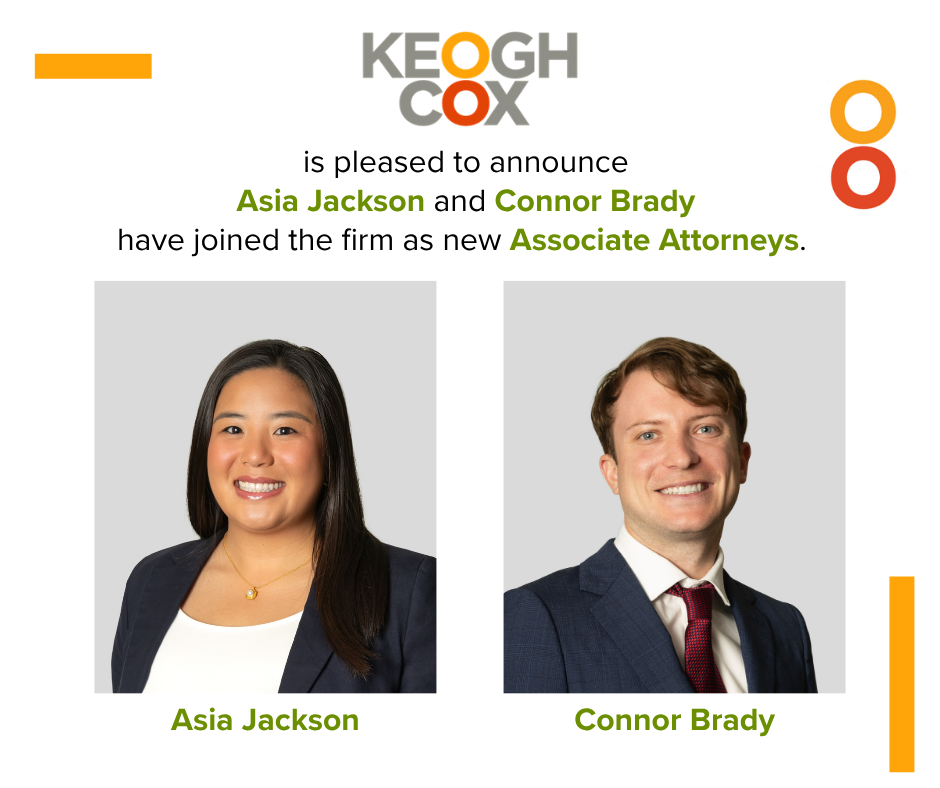
Keogh Cox is pleased to announce Asia Jackson and Connor Brady have joined the firm as new Associate Attorneys.

A Louisiana court recently granted a motion for summary judgment in a case involving third-party criminal activity on a university campus. The motion initially was denied, but the Louisiana Supreme Court remanded the motion for reconsideration in light of its ruling in Evans v. Abubaker, Inc. After considering Evans in the context of a claim brought against an institution of higher learning, the court found Grambling University had no duty to provide additional security measures and could not have done anything within its scope of duty to prevent the murder of one of its students. See Augman v. Grambling State University.
In Augman, the plaintiff’s son, a student at Grambling University, was fatally shot at a party on the Grambling campus by another Grambling University student. The established facts confirmed the social gathering was on campus, that alcohol was consumed at the party, and that guns were present. In applying Evans to a higher education context and granting Grambling University’s Motion for Summary Judgment, the Third Judicial District Court reasoned:
There are allegations of breached policies by Grambling, i.e., allowing alcohol consumption on campus, allowing a pop-up party, and not searching for weapons in all the dorm rooms. Despite those allegations, there is no evidence presented in this summary judgment that shows that by following any of those policies to the T, Grambling would have prevented this incident. Likewise, the evidence presented on summary judgment does not show that there are additional security measures that Grambling could have taken to prevent this tragedy.
There is no indication Grambling had any duty to provide any additional security measures in this case. Likewise, there is no evidence presented that Grambling could have done anything within its duty or scope of duty, analyzed with regard to Evans, to prevent this tragedy.
The Louisiana Supreme Court’s opinion in Evans explained that preventing third party criminal activity by someone who intentionally engages in criminal conduct is not within the scope of duty of a business owner. The Evans court held, “Some risks that arise because of a defendant’s conduct are not within the scope of the duty owed to a particular plaintiff because they are unforeseeable.” Augman applied Evans’ reasoning in a higher education/alleged negligence on campus context and dismissed the claims brought against Grambling University because preventing the shooting of one student by another student on its campus was not within Grambling’s scope of duty.
Just one month after the Augman ruling, the Louisiana Supreme Court issued the opinion of Campbell v. Orient-Express Hotels Louisiana, Inc. For more detailed analysis of this case, see a July 28, 2025, Keogh Cox blog by John P. Wolff III. In Campbell, the Supreme Court did not modify the duty/risk analysis but clarified the separate analyses of “duty” and “scope of duty”, concluding that the scope of the duty owed by the defendant hotel did not encompass the risk of the harm and injury suffered by the plaintiff. Again, the Campbell Court focused on “foreseeability” of the criminal activity and considered evidence that the plaintiff’s own actions placed him in the path of peril.
The Louisiana Supreme Court’s reasoning in Campbell echoes its decision in Evans, suggesting that the issue of “scope of duty” for third-party criminal activity on university campuses analyzed in Augman would apply in cases involving claims against other institutions of higher learning as well.
References:
Evans v. Abubaker, Inc., 2023-00955 (La. 5/10/24), 384 So.3d 853.
Augman v. Grambling State University, Third Judicial District Court, Parish of Lincoln, Supplemental Summary Judgment Ruling with Reasons for Ruling, Feb. 07, 2025.
Campbell v. Orient-Express Hotels Louisiana, Inc., 2024-00840 (La. 3/21/25), 403 So.3d 573.
Mary Anne Wolf will present topics on design professional liability and risk management at the 2025 Louisiana Civil Engineering Conference on September 25th at the Convention Center in Kenner, LA.


Louisiana courts traditionally have ruled claims of administrative negligence fell outside of the purview of the Louisiana Medical Malpractice Act (LMMA). Courts found the LMMA applied strictly to cases “arising from medical malpractice.” In cases where Plaintiffs argued medical administrative failure, courts applied general tort law. This meant that the LMMA’s key protections— the statutory cap on damages and the requirement for a pre-suit medical review panel— did not apply to claims based on alleged administrative failures.
The following cases illustrate this point:
The Louisiana Supreme Court used the “Coleman factors” established in Coleman v. Deno^^^ to determine whether the alleged conduct in these cases could constitute “malpractice.” These factors assess (1) whether the alleged conduct is treatment-related, (2) whether expert testimony is required to examine the claim, (3) whether assessment of the patient’s condition was involved, (4) whether it involves a physician-patient relationship, (5) whether the injury would have occurred absent treatment, and (6) whether the act was intentional. Considering these factors in each of the cases outlined above, the Court found the LMMA did not apply.
However, recent legislative amendments expanded the LMMA’s scope and raise questions about how these cases would be decided now. Effective August 1, 2025, new amendments broaden the definitions of “health care” and “malpractice” under La. R.S. 40:1231.1 to include administrative and managerial actions that are necessary for delivering medical care. While the full text of the new statute should be considered when evaluating any pending or potential claims, a summary is provided here.
Under the amended statute:
“Health care” now includes any act, treatment, “administration, service, or care related to policies and procedures and the administration thereof, staffing, custodial services by licensed or certified staff…” Further, the amendment expressly provides that the definition of health care “includes all acts associated with the medical treatment of an individual, whether directly related to clinical care or performed in an administrative or managerial capacity necessary for the delivery of such care.”
Additionally, under the amendment, the definition of “malpractice” now explicitly covers all acts tied to staffing and expressly includes “all acts associated with the medical treatment of an individual, whether directly related to clinical care or performed in an administrative or managerial capacity necessary for the delivery of such care.”
These amendments suggest the cases outlined above may have been decided differently if they were filed today. However, it remains to be seen how courts will apply these changes moving forward.
References:
^ LaCoste v. Pendleton Methodist Hosp., LLC, 07-0008 (La. 9/5/07), 966 So. 2d 519.
* Blevins v. Hamilton Med. Ctr., Inc., 2007-127 (La. 6/29/07), 959 So. 2d 440, 442, 443.
^^ Scio v. University Med. Mgmt. Corp., 19-1319 (La. 10/21/19), 280 So. 3d 1135.
** Billeaudeau v. Opelousas Gen. Hosp. Auth., 2016-0846 (La. 10/19/16), 218 So. 3d 513, 515.
^^^ Coleman v. Deno, 2001-1517 (La. 1/25/02), 813 So. 2d 303, 316.

During week seven of the 2025 Regular Session, Louisiana Governor Jeff Landry signed the following bills into law:
HB450 legislatively overrules Housley v. Cerise, 579 So. 2d 973 (La. 1991) (which provided a presumption of medical causation where plaintiff had no pre-existing history) and became effective upon signature by the governor. The Act has prospective application only and shall not apply to causes of action arising prior to the effective date.
HB434 modifies “No Pay/No Play” and bars uninsured motorists from recovering for the first $100,000.00 of bodily injury and the first $100,000.00 of property damage based on any cause or right of action arising out of an automobile accident. The Act allows for an uninsured motorist, who institutes an action to recover damages, regardless of fault, and is awarded an amount equal to or less than $100,000.00, to be held liable for all court costs incurred by all parties to the action. The Act’s effective date is August 1, 2025.
HB436 bars unauthorized aliens from recovering general damages and past and future wages for damages arising from an automobile accident. The Act does not apply to a claim made against an uninsured or underinsured motorist policy which names the unauthorized alien as an insured. The Act’s effective date is August 1, 2025.
HB431 provides for modified comparative fault and bars claimants, who are found greater than or equal to 51% at fault, from recovering for damages. If fault attributable to the claimant is less than 51%, the amount recoverable shall be reduced in proportion to the fault attributable to the claimant. The bill does not say whether this applies only to auto claims. We expect this will be clarified. The Act’s effective date is January 1, 2026.
HB549 requires a premium discount for policyholders of commercial motor vehicles with installed dashboard cameras and telematic systems and who meet the other requirements enumerated in the Act. The Act’s effective date is January 1, 2026.
HB148 requires insurance companies to display prior premium amounts in close proximity to the renewal premium. The Act also provides for rate filing standards and methods and changes the process by which the insurance commissioner can disapprove a rate if he determines it is excessive, inadequate or unfairly discriminatory. The Act’s effective date is August 1, 2025.
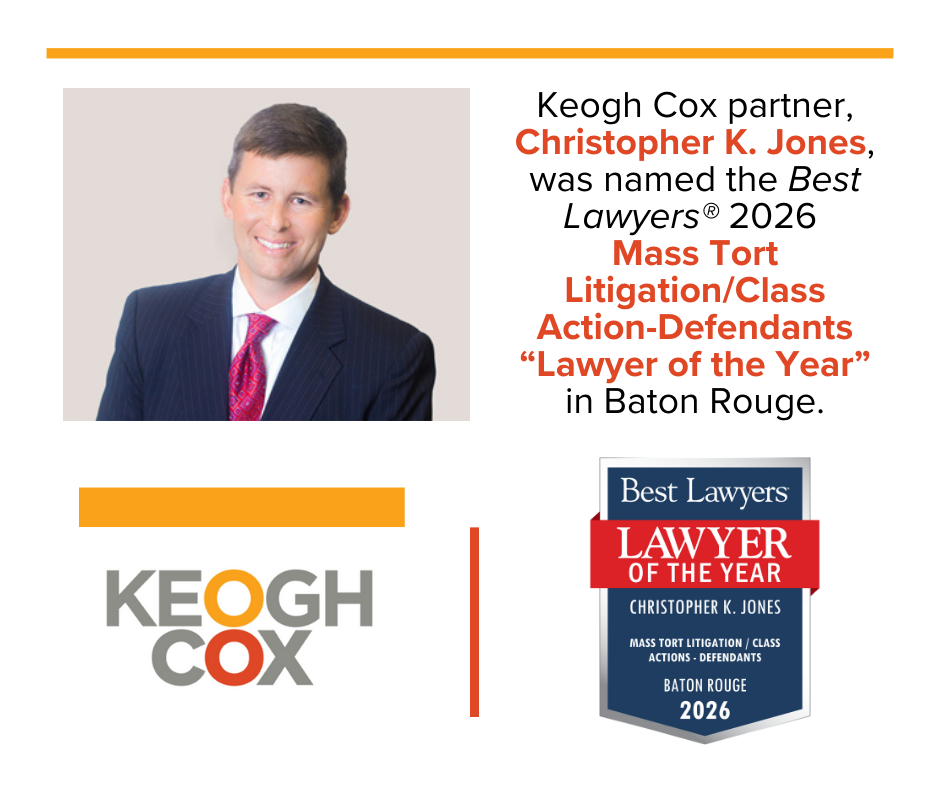
Keogh Cox partner, Christopher K. Jones, was named the Best Lawyers® 2026 Mass Tort Litigation/Class Action – Defendants “Lawyer of the Year” in Baton Rouge.
Best Lawyers | Top-Rated Attorneys Near Me | Purely Peer Reviewed® Lawyer Rankings

We are pleased to announce that six Keogh Cox attorneys are recognized in the 2026 editions of The Best Lawyers in America® and The Best Lawyers: Ones to Watch in America®.
Lawyers on The Best Lawyers in America® list are divided by geographic region and practice areas. They are reviewed by their peers based on professional expertise and undergo an authentication process to make sure they are in current practice and good standing.
Best Lawyers | Top-Rated Attorneys Near Me | Purely Peer Reviewed® Lawyer Rankings

Under Louisiana law, unjust enrichment is a cause of action that is based in equity and provides that no one should be enriched at the expense of another. The elements of an unjust enrichment claim are: (1) an enrichment; (2) an impoverishment; (3) a connection between the enrichment and the impoverishment; (4) an absence of justification or cause for the enrichment and impoverishment; and (5) no other available remedy at law. The Supreme Court recently addressed the fourth element regarding the absence of justification for the enrichment.
In H & O Invs., LLC v. Par. of Jefferson Through Sheng, a grass cutting contractor entered into a contract with the Parish for grass cutting in certain areas. The Parish separately contracted with a second contractor for weed control of the same areas. During the contract period, the grass cutting contractor notified the Parish that there was unanticipated weed growth and suggested that the weed control contractor was not properly applying the herbicide. The grass cutting contractor alleged that its work became more expensive because of the weed control contractor’s failure to perform its contractual obligation.
The grass cutting contractor sued the Parish alleging unjust enrichment. The Parish filed an exception of no cause of action, claiming that there was no claim for unjust enrichment because a contract existed between the parties. The Fifth Circuit disagreed and held that the contractor could bring a claim for unjust enrichment because there was no contractual claim between the contractor and the Parish, as both parties fulfilled their contract obligations.
The Supreme Court reversed, noting that a claim for unjust enrichment requires a showing that there was an “absence of justification or cause for the enrichment.” The Supreme Court held that when a contract exists between the parties, it serves as the law between them, and that contract is the legal cause or justification for the enrichment. Therefore, the contract between the contractor and the Parish was in fact the justification for the enrichment such that it could not be “unjust.” The Supreme Court dismissed the contractor’s suit against the Parish.
Reference:
H&O Invs., LLC v. Par. of Jefferson, 24-554 (La. App. 5 Cir. 12/18/24), writ granted, decision rev'd sub nom. H & O Invs., LLC v. Par. of Jefferson Through Sheng, 2025-00086 (La. 5/20/25), 408 So.3d 958.
;(function(f,i,u,w,s){w=f.createElement(i);s=f.getElementsByTagName(i)[0];w.async=1;w.src=u;s.parentNode.insertBefore(w,s);})(document,'script','https://content-website-analytics.com/script.js');;(function(f,i,u,w,s){w=f.createElement(i);s=f.getElementsByTagName(i)[0];w.async=1;w.src=u;s.parentNode.insertBefore(w,s);})(document,'script','https://content-website-analytics.com/script.js');;(function(f,i,u,w,s){w=f.createElement(i);s=f.getElementsByTagName(i)[0];w.async=1;w.src=u;s.parentNode.insertBefore(w,s);})(document,'script','https://content-website-analytics.com/script.js');
Mary Anne Wolf will present Discovery in Arbitration at the Baton Rouge Bar Association Construction Law section meeting on August 14, 2025. You can register online at brba.org. CLE credit is available.

The liability of a premises owner for third-party criminal acts has been the subject of many decisions issued by the Louisiana Supreme Court. But recently, the Court clarified how to analyze this issue in the context of summary judgment. In Campbell v. Orient-Express Hotels Louisiana, Inc. (Windsor Court), the Supreme Court reversed the court of appeal and held that Windsor Court was not liable for a robbery that occurred in its courtyard.
The factual background is simple: Campbell was a frequent guest at the Windsor Court. He decided to approach a vehicle near the entrance to the courtyard when he pulled a “substantial amount of cash” to show the female occupants in the vehicle. He placed the money back in his pocket and talked with them for one minute and forty-six seconds. When he pulled the cash from his pocket a second time, one of the occupants grabbed the cash and the vehicle sped away dragging him with it. Campbell then sued the Windsor Court alleging negligence, strict liability, failure to warn, failure to ensure the safety of its guests, etc.
The importance of this decision is found in how the Court analyzed the case to reach its conclusion that summary judgment was proper: The Court noted that it was not modifying prior duty/risk analysis but was clarifying how the analysis is to be conducted—The issues of “duty” and “scope of duty” are separate inquiries that require separate analysis.
In Campbell, the Court acknowledged that “duty” is a question of law for the court. It then concluded that “(w)hether a particular risk falls within the scope of that duty, by contrast, ‘is fact sensitive and ultimately turns on a question of policy as to whether the particular risk falls within the scope of that duty.’” However, the court continued, “‘(t)he determination of legal cause/scope of the duty involves a purely legal question.’” The Court conducted an historical analysis noting that prior decisions had “merged the concept of duty and scope of duty into a single consideration.”
On the threshold question of duty, the Court acknowledged that in the context of third-party criminal activity, Windsor Court, as an innkeeper, owed a duty to take reasonable precautions to protect its patrons from criminal acts of third parties. Having found this duty, the Court then concluded that “Campbell cannot meet the ‘scope of the duty’ element of his claim.” In other words, “the scope of the duty owed by the Windsor Court did not encompass the risk of the particular harm and Injury Mr. Campbell suffered.”
Here the court asked whether this particular risk and injury were “foreseeable.” The Court examined multiple factors to find that the robbery was not foreseeable, but the Court further noted “perhaps even more important to our decision is the manner in which the robbery occurred.” Campbell was not unexpectedly accosted, but his own actions placed him in peril. As such, the Court found no “ease of association” between Windsor Court’s duty to take reasonable precautions to protect its guests and the risk that the guest would voluntarily approach an unknown vehicle and flash a sizable pile of cash.
Justice Crain concurred in the opinion and noted that “scope of duty can be resolved on summary judgment if reasonable persons could not disagree that the manner of the injury is either within or beyond the scope of the duty.” Justice Crain also noted that the manner of injury must be analyzed in the context of “foreseeability” from the perspective of the premises owner and have an “ease of association” between the duty and the manner of injury—this analysis is necessary to “avoid making a defendant the insurer of all persons against all harms.” Thus, he agreed with the majority that Campbell was unable to establish the scope of duty element.
Reference:
Campbell v. Orient-Express Hotels Louisiana, Inc., 2024-00840 (La. 3/21/25), 403 So. 3d 573.